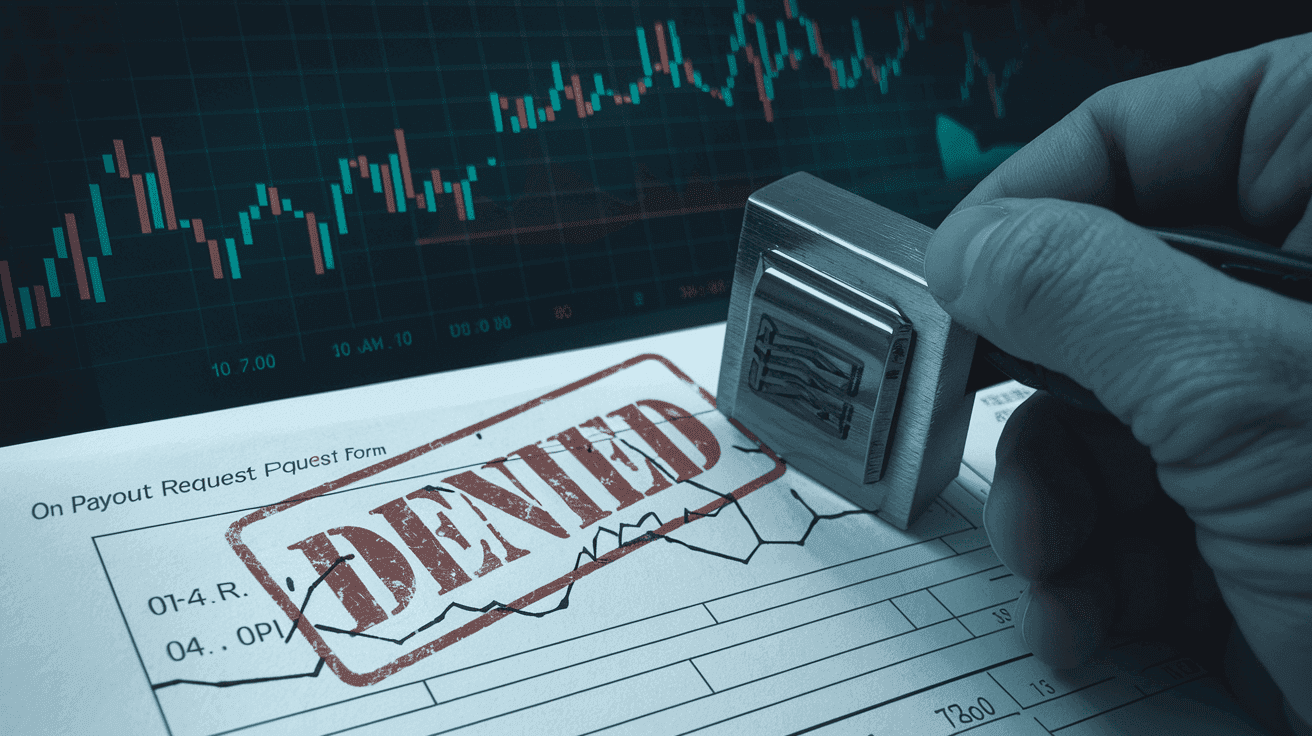
FTMO's $20 Payout Denial: Is Slippage the New Excuse to Dodge Profits?
A trader risked 0.95% on a $100K FTMO account, staying well under their 1% limit. But slippage pushed the loss to $1,020 instead of $950 — a mere $70 overage. FTMO denied the entire payout. The forex community is calling it predatory, and they might have a point.
The Viral Complaint That Started It All
On January 15, 2026, @PropFirmMedia posted what would become the most shared FTMO complaint of the year. The story was simple but infuriating: A trader on a $100K funded account had successfully made their first payout with FTMO. Then came the hidden rule.
Post-first-payout, FTMO imposed a 1% risk restriction per trade. The trader, knowing this, carefully sized their position for 0.95% risk — $950 on a $100K account. They left a 0.05% buffer specifically to account for slippage. Smart, right?
Wrong. The trade closed at -$1,020 due to spread and slippage. A $70 overage — less than 0.1% of the account — and FTMO denied the entire payout. The trader had followed every visible rule, planned for execution costs, and still got burned by technicalities.
@PropFirmMedia's caption said it all: "STOP DENYING LEGIT PAYOUTS" with FTMO tagged directly. The post exploded across prop trading Twitter, Reddit, and Discord servers. Traders started sharing their own slippage denial stories.
What Actually Happened: The Timeline
📈 First Payout Success
The trader passed their FTMO challenge and verification, then successfully withdrew their first payout. Everything normal so far. FTMO processed the payment within their standard timeframe, and the trader thought they'd found their long-term funding partner.
🚫 The Hidden Restriction
After the first payout, FTMO quietly implemented their "1% risk per trade" rule. This isn't in their main terms of service. It's not mentioned during the challenge phase. It only appears after you've proven you can make money consistently — which, cynically, is exactly when a prop firm would want to limit your upside.
🎯 Conservative Position Sizing
Knowing about the restriction, the trader sized their next position for 0.95% risk. On a $100K account, that's $950 maximum loss. They deliberately stayed under the 1% threshold to account for slippage — exactly what any risk-conscious trader should do.
💸 Slippage Strikes
Market execution is never guaranteed. The trade that was supposed to lose a maximum of $950 actually lost $1,020 due to spread widening and slippage. A mere $70 difference — 0.07% of the account value. Any reasonable firm would consider this normal execution variance.
❌ Denial and Justification
FTMO denied the payout, citing the 1% rule breach. When the denial went viral on social media, FTMO defended it as a "straightforward breach of contract." But here's the problem: the trader never intended to breach any rule. They planned conservatively and got hit by market reality.
FTMO's Official Slippage Rules (And What They Don't Tell You)
FTMO's public documentation explains slippage as a normal part of live market execution. They explicitly state that slippage can occur both positively and negatively, and that they use real market conditions rather than instant execution.
🔍 What FTMO Says About Slippage:
- Live execution model: Orders routed to real liquidity providers
- No hidden markups: Executions follow visible platform pricing
- Simulated delays: Up to 200ms to mimic live conditions
- Normal occurrence: Expected during news, rollovers, low liquidity
- Both directions: Can help or hurt your trades
But here's what they don't tell you: if slippage causes you to breach their post-payout risk limits by even a few dollars, you lose your entire payout. There's no grace period, no rounding, no consideration for the fact that you planned responsibly.
📋 The Hidden Post-Payout Rules
According to multiple trader reports, FTMO implements several restrictions after your first successful payout that aren't clearly disclosed upfront:
The Slippage Problem: Why It's Getting Worse
Slippage isn't just a minor inconvenience — it's becoming a systemic issue that prop firms are weaponizing against profitable traders. Here's why:
📊 Market Structure Changes
Modern forex markets are more volatile and fragmented than ever. The 2025-2026 period has seen increased slippage across all major pairs due to:
- Algorithmic trading dominance: 80%+ of volume is now algorithmic, leading to rapid price gaps
- Reduced market maker presence: Banks have scaled back forex market making
- Crypto correlation spillover: Traditional FX now mirrors crypto volatility during major moves
- Geopolitical uncertainty: Events trigger instant liquidity droughts
🎯 Selective Enforcement
Multiple traders have reported that FTMO seems to enforce slippage rules more strictly on profitable accounts. During the challenge phase, similar slippage amounts are overlooked. But once you're making money consistently, every pip counts against you.
@unclebobo_fx noted on Twitter: "Funny how slippage never mattered during my challenge, but now that I'm profitable, they're measuring it to the penny." This pattern suggests slippage enforcement may be used as a profit control mechanism rather than genuine risk management.
💰 The Business Model Problem
Prop firms make money two ways: challenge fees and spread markups. They lose money when traders consistently withdraw profits. Slippage denials serve as a convenient way to retain trader profits while appearing to follow "rules."
Industry insiders estimate that for every 100 challenge attempts, only 2-5 traders become consistently profitable. When one of those traders gets denied over $70 of slippage, it saves the firm thousands in potential future payouts.
How Other Firms Handle It Better
Not all prop firms use slippage as a gotcha mechanism. Several major firms have policies that protect traders from execution variance:
🟢 TopStep's Approach
TopStep focuses on end-of-day drawdown calculations rather than per-trade risk limits. Slippage on individual trades doesn't trigger rule breaches unless it affects your daily or maximum drawdown limits. This gives traders breathing room for normal execution variance.
🟢 APEX Trader Funding's Buffer
APEX builds slippage tolerance into their platform. Their trailing drawdown calculation includes a small buffer for execution variance. Traders report that minor slippage (under 0.1% of account value) rarely triggers violations.
🟢 MyForexFunds' Transparency
MFF explicitly states in their terms that normal slippage won't be grounds for account termination. They provide clear slippage statistics and work with traders to resolve execution disputes. Their customer service actually responds to slippage complaints with data, not form letters.
How to Protect Yourself From Slippage Denials
Until prop firms fix their slippage policies, traders need defensive strategies. Here's how to trade with FTMO (and similar firms) without getting burned:
📏 Conservative Position Sizing
If the limit is 1%, risk 0.7% maximum. If slippage can add 0.2-0.3% to your loss, size accordingly. It sucks to leave money on the table, but getting denied over $50 sucks more.
- $100K account: Risk $700 max if 1% limit applies
- $50K account: Risk $350 max
- $25K account: Risk $175 max
⏰ Avoid High-Slippage Periods
Don't trade during market transitions, news events, or low-liquidity hours if you're near risk limits:
- Session overlaps: NY open (8:30 AM EST), London close (11:00 AM EST)
- News releases: NFP, CPI, FOMC minutes, ECB decisions
- Market gaps: Sunday night opens, holiday reopenings
- Rollover periods: 5:00 PM EST daily, month-end flows
📊 Document Everything
Screenshot your position sizing calculations, entry orders, and execution prices. If you get denied, you'll need evidence that you planned conservatively and got hit by normal market conditions.
🔄 Diversify Across Firms
Don't put all your trading capital with one prop firm. Run challenges with TopStep, APEX, and MyForexFunds simultaneously. If one firm starts playing games with slippage, you have alternatives.
💬 Join Trader Communities
Follow prop firm watchdog accounts like @PropFirmMedia, @PropFirmBrigade, and join Reddit communities like r/PropFirmTester. When firms start denying payouts systematically, these communities sound the alarm first.
The Bigger Picture: What This Means for Prop Trading
The slippage excuse represents a broader trend in prop firm gatekeeping. As more traders become profitable and the industry matures, firms are finding increasingly creative ways to retain trader profits.
🎯 The Pattern is Clear
Hidden post-payout restrictions, zero-tolerance slippage policies, selective enforcement — these aren't isolated incidents. They're systematic approaches to reduce payout obligations while maintaining the appearance of legitimate business practices.
📈 Market Pressure is Building
Trader advocacy is working. When denial stories go viral, it hurts firm reputations and drives customers to competitors. FTMO's aggressive defense of the $20 denial suggests they're feeling the pressure.
The firms that adapt by treating slippage fairly will win long-term. The ones that double down on technicalities will lose traders to more reasonable competitors.
Our Verdict: Choose Better Firms
FTMO's $20 denial isn't just about one trader or one payout. It's about a firm prioritizing profits over fairness. When a trader follows all visible rules, plans conservatively for slippage, and still gets penalized for normal market execution, the system is broken.
Slippage isn't controllable by traders. It's a market reality that prop firms should account for in their risk management, not use as a gotcha against profitable traders.
The good news? You have choices. Firms like TopStep, APEX Trader Funding, and MyForexFunds handle slippage more fairly. They focus on overall performance rather than hunting for technicalities to deny payouts.
Until FTMO fixes their slippage policy, we recommend exploring alternatives. Your trading skills are valuable — don't let a firm profit from technicalities while you do all the work.
Use our Prop Firm Comparison Tool to see how FTMO stacks up against alternatives, or check our PropScorer rankings to find firms that won't penalize you for market realities beyond your control.
Frequently Asked Questions
Is the 1% risk rule clearly stated in FTMO's terms?
No. FTMO's public terms mention 1-1.5% risk per trade as a "best practice" suggestion, not a hard rule. The post-payout 1% enforcement appears to be an internal policy that's applied selectively. Many traders report being surprised by this restriction after their first payout.
How much slippage is normal in forex trading?
Normal slippage on major pairs ranges from 0.1-0.5 pips during regular market hours, but can spike to 2-5+ pips during news events, session overlaps, or low liquidity periods. The $70 overage in the viral case represents about 2-3 pips of slippage, which is well within normal ranges for market conditions.
Which prop firms are most lenient with slippage?
TopStep and MyForexFunds have the most trader-friendly slippage policies. TopStep focuses on end-of-day drawdown rather than individual trade execution, while MyForexFunds explicitly states that normal slippage won't trigger account violations. Both firms work with traders to resolve execution disputes rather than using them as denial excuses.
Can I appeal a slippage-based payout denial?
You can try, but success rates are low with FTMO. Document everything: your position size calculations, intended risk percentage, and actual execution data. Some traders have succeeded by demonstrating they planned conservatively and providing evidence of normal market conditions during their trade execution. Consider posting your case publicly on Twitter or Reddit — viral complaints sometimes get resolved faster than private appeals.