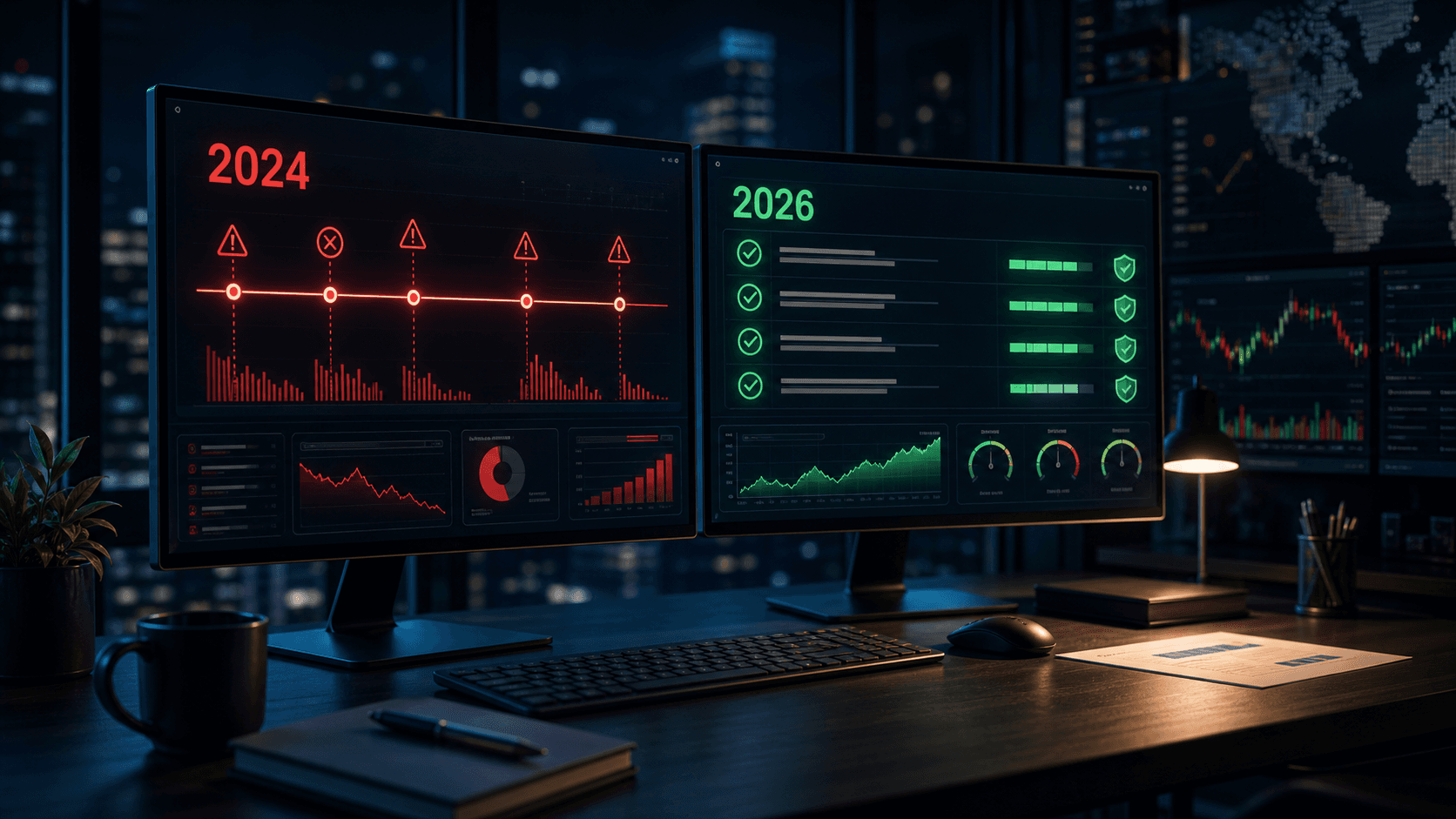
How the 2024 Prop Firm Shutdown Wave Changed Trader Due Diligence in 2026
The 2024 shutdown wave permanently changed how serious traders evaluate prop firms. Before it, due diligence often meant comparing prices, account sizes, profit splits, and drawdown rules. In 2026, that is not enough. The real question is no longer “Which challenge is cheapest?” It is “Which firm can still pay clean traders when conditions get ugly?”
The lesson was brutal: a prop firm can look healthy from the outside while liquidity, broker access, rule enforcement, and payout queues are already deteriorating behind the scenes. Traders who ignored those signals learned that passing an evaluation is worthless if the business model behind it cannot survive profitable customers.
What Actually Changed After 2024
The shutdown wave turned prop firm selection from a shopping exercise into counterparty risk analysis. Traders started asking sharper questions: Who owns the company? How long has it operated under the same rules? Are payouts public, recent, and independently discussed? Does the firm depend on constant discount campaigns to fund obligations?
In 2026, credible due diligence has three layers. First, rule quality: are the rules clear, stable, and tradable? Second, operating quality: support, platforms, data feeds, and breach handling. Third, financial behavior: payout speed, complaint patterns, promo intensity, and whether profitable traders are treated as customers or liabilities.
The New 2026 Due Diligence Checklist
Start with survival signals. Check domain age, entity history, leadership visibility, broker/platform partners, public rule-change history, and whether the firm has survived at least one full market cycle with real payouts. New firms are not automatically bad, but they should be sized like venture risk, not treated like established infrastructure.
Then check payout reliability. Look for recent trader reports across X, Discord, Reddit, Trustpilot, and independent communities. A few complaints are normal. A cluster of delayed payouts, manual reviews after profit requests, sudden KYC friction, or “compliance” language appearing only after traders win is a major warning sign.
Finally, test rule integrity. Good rules are specific. Bad rules rely on phrases like “abusive trading,” “gaming the system,” or “risk team discretion” without measurable definitions. Ambiguity is where profitable traders get trapped.
Red Flags That Matter More Now
The most dangerous red flag in 2026 is not a bad Trustpilot score. It is a change in behavior. A firm that suddenly increases discounts, extends payout review windows, changes funded-account rules, blocks winning strategies, or pushes traders into new account types may be under stress.
Watch for social rotation too. When a firm spends aggressively on influencers while unresolved payout complaints keep appearing, the marketing engine may be outrunning the operating engine. That does not prove fraud, but it does mean you should reduce exposure until the data improves.
How Traders Should Adapt
Treat prop firm accounts like portfolio positions. Do not concentrate all evaluation fees, funded accounts, and payout expectations in one firm. Diversify across business models, keep screenshots of rules when you buy, save support transcripts, and withdraw early rather than maximizing paper balance.
The best due diligence habit is a pre-purchase memo. Before buying, write down the firm, plan, exact rules, total fees, payout threshold, first withdrawal date, known complaints, and your reason for trusting the firm. If you cannot justify the purchase in five clean lines, the discount is probably doing the thinking for you.
What PropScorer Looks At
PropScorer is built around the post-2024 reality: rules are only one part of risk. Our scoring weighs plan economics, restrictions, payout friction, reputation signals, and trader-fit. A firm can have attractive pricing and still be a poor choice if the complaint pattern or rule design creates asymmetric risk for winning traders.
That is why due diligence should combine ranking data with qualitative reading. Use scores to narrow the field, then read the review, compare plans, and check current payout intelligence before committing capital.
Bottom Line
The 2024 shutdown wave did not kill prop trading. It professionalized the buyer. In 2026, the edge belongs to traders who evaluate firms like counterparties, not coupons. Cheap challenges are easy to find. Durable payout partners are rarer.
Frequently Asked Questions
Should I avoid every new prop firm?
No. But size the risk correctly. A new firm needs clearer ownership, transparent rules, and stronger payout proof than an established firm.
Are payout screenshots enough?
No. Treat them as weak evidence unless they are recent, repeated, and supported by independent trader discussion or verifiable transaction context.
What is the biggest mistake traders still make?
Buying because of a discount before checking payout history, rule-change behavior, and whether the rules still work after funding.
Next Step
Run your shortlist through the PropScorer firm directory, read detailed prop firm reviews, compare exact costs with the value comparison tool, check payout intelligence, and monitor fresh risk signals in PropScorer Radar.