Phoenix Trader Funding Review 2026: Classic, Spark, Ascension and Merit Compared
Phoenix Trader Funding is a newer Paris-based futures prop firm with more than one offer hiding under the headline. The useful map is Classic, Spark, Ascension and Merit: each route changes the drawdown model, consistency rule, activation fee and payout path.
That makes Phoenix interesting, but it also makes lazy comparisons dangerous. Spark is not Classic. Ascension is not a trailing-drawdown account. Merit is not a normal profit-target challenge. Traders should pick by route, not by the cheapest 25K banner.
Quick Verdict
Phoenix Trader Funding is a monitored challenger with unusually flexible route design. It looks best for traders who want cheap 25K/50K access, no daily loss limit, and a clear path from simulated payouts toward Live Funding. It is weaker for traders who want a long, mature payout record before buying.
| Best for | Budget-conscious futures traders comparing Classic/Spark low-cost access against Ascension static drawdown. |
| Avoid if | You require years of payout proof, or you dislike track-specific payout and consistency rules. |
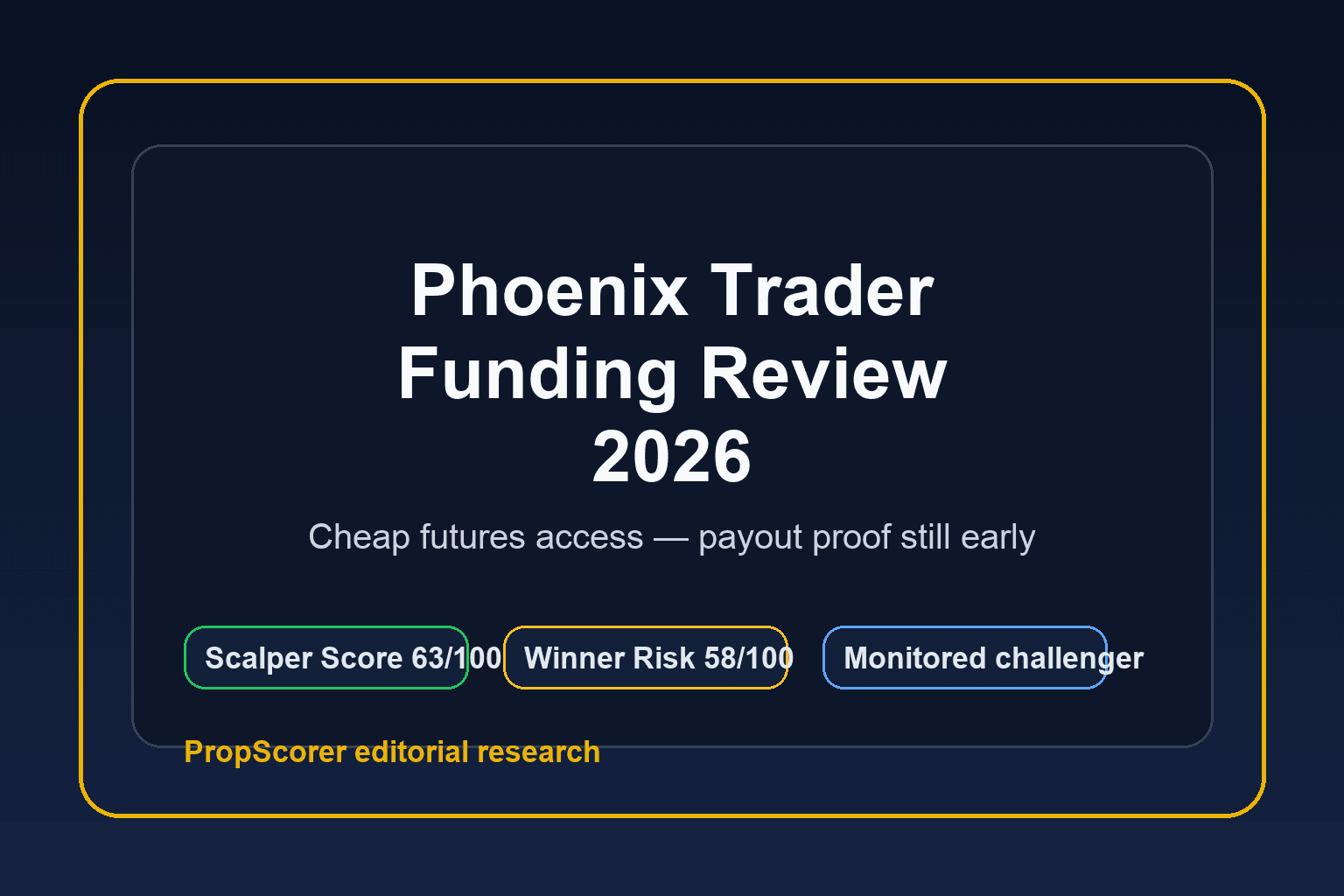
| Scalper Score | 70/100 current research score — no DLL and multiple route choices help, while young-firm proof gaps still cap the rating. |
| Winner Risk Score | Moderate — better rule transparency than many new firms, but repeat-payout evidence still needs monitoring. |
Four Routes, Four Different Trade-Offs
Classic is the standard EOD trailing route: 25K to 150K, roughly 6% targets, no daily loss limit, and a 50% evaluation consistency rule. Funded consistency is not the bottleneck on Classic; the evaluation distribution rule is.
Spark is the cheaper 25K/50K path: one day to pass, no consistency, no buffer, no daily loss limit, and a $29 activation fee. That is the cleanest small-test route if the trader accepts newer-firm risk.
Ascension is the different one: static drawdown instead of trailing, 40% consistency, built-in buffer and a scaling path. Merit removes the normal profit target and runs as a 30-day quality review with adaptive economics, so it should not be compared like a regular cheap challenge.
The Scalper Angle
Phoenix has enough in the rule structure to interest futures scalpers. No daily loss limit across the main routes is a real positive because daily hard stops can kill otherwise valid intraday strategies. The choice between EOD trailing on Classic/Spark and static drawdown on Ascension is the central risk-management decision.
The score stays moderate because the track friction moves around rather than disappears. Classic has 50% consistency, Ascension has 40%, Merit is qualitative, and Spark is cleanest but limited to smaller sizes. Phoenix may fit disciplined scalpers better than high-variance traders.
Payouts and Live Path
The core payout headline is strong: 100% of the first $10,000 in trader payouts, then 90/10. Phoenix also lists a low $75 minimum payout, first payout availability in roughly 2-6 days depending on route, and bi-weekly payouts after the first request.
The Live Funding path is real but conditional. Treat it as a review path after successful payout history, not as a guaranteed immediate conversion. Phoenix also sells ecosystem tools around the account, including Thor trade copier, analytics, and data/feed options such as Rithmic, dxFeed and TFeed.
Winner Risk: The Real Question
The issue with Phoenix is not that the offer looks bad. It does not. The issue is that profitable-trader safety is still under-proven. Young brands can look excellent during acquisition, then become harder to judge once traders start requesting repeat payouts, scaling capital, or hitting edge cases in the rulebook.
Conditional live funding language after multiple payouts is worth watching closely. It may be reasonable operationally, but traders should understand exactly when simulated payout success converts into stronger funding proof and whether larger winners are treated consistently.
Bottom Line
Phoenix Trader Funding belongs on the comparison list, not the blind-trust list. Spark is the small-test value route, Classic is the normal EOD challenge, Ascension is the static-drawdown alternative, and Merit is a quality-review experiment. The mechanics are interesting, but until payout proof, support quality, and funded-account handling mature, Phoenix should remain a monitored challenger rather than a core safe pick.